

 English
  русский
Sludge Dewatering Machine: Types, Working Principles, and Selection Guide
Content
What a Sludge Dewatering Machine Does and Why It Matters
A sludge dewatering machine reduces the water content of sludge generated by wastewater treatment, industrial processes, and municipal systems — converting a pumpable slurry into a semi-solid cake that can be transported, landfilled, composted, or incinerated at a fraction of the cost of handling liquid sludge. The core objective is to reduce total sludge volume as aggressively as possible, since water content typically accounts for 95–99% of raw sludge by weight before dewatering.
Reducing sludge volume directly lowers downstream disposal costs. A municipal wastewater plant producing 10,000 tonnes of sludge per year at 97% moisture can reduce that volume to under 1,500 tonnes of cake at 75% moisture — cutting haulage, landfill tipping fees, and incineration fuel consumption by more than 80%. This economic driver is why dewatering equipment represents one of the highest-ROI capital investments in sludge management infrastructure.
The machines operate across municipal sewage treatment, food and beverage production, paper and pulp mills, mining tailings management, pharmaceutical manufacturing, and chemical processing — wherever solid-liquid separation is required at scale.
Main Types of Sludge Dewatering Machines
Several dewatering technologies are in active use, each operating on a different physical principle and suited to different sludge types, throughput requirements, and final cake dryness targets.
Belt Filter Press
The belt filter press uses two continuously moving porous belts to sandwich conditioned sludge and progressively squeeze it through a series of rollers of decreasing diameter. The process has three zones: gravity drainage, where free water falls through the lower belt; a wedge zone, where the belts converge and begin applying pressure; and a pressure zone, where the sludge passes through S-shaped roller configurations that apply shear and compression simultaneously. Cake dryness typically reaches 18–25% dry solids for municipal biosolids. Belt presses are well-suited to continuous high-volume operation and have relatively low energy consumption, but require significant wash water to keep the belts clean and are sensitive to fibrous or abrasive sludge that accelerates belt wear.
Centrifuge Decanter
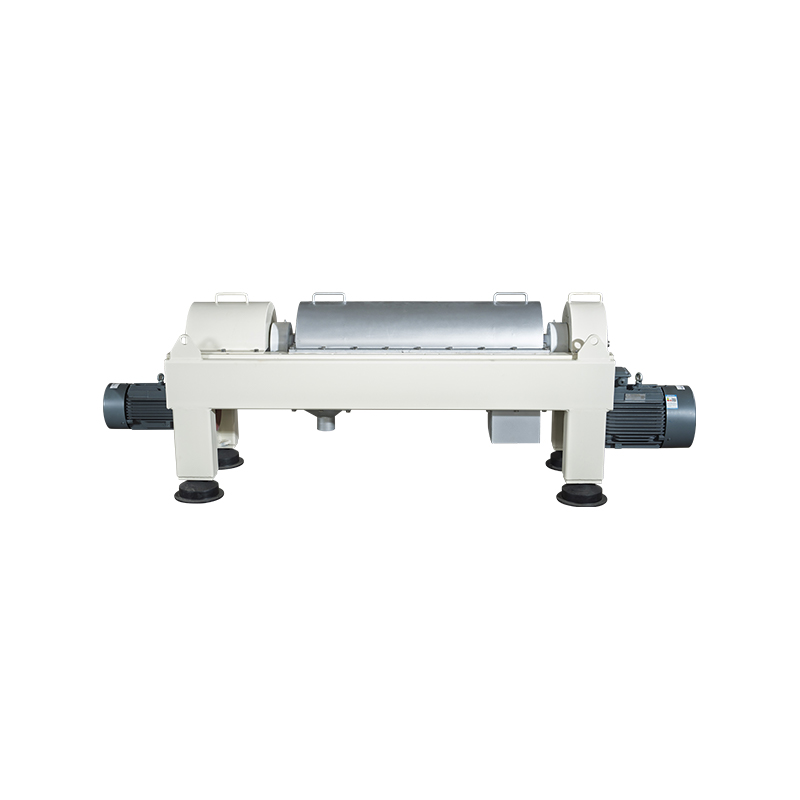
Centrifuge decanters use high rotational speeds — typically 2,000–4,000 RPM, generating centrifugal forces of 1,500–3,000 × g — to accelerate sedimentation. Sludge is fed into a horizontal rotating bowl; the heavier solids migrate to the bowl wall and are continuously conveyed to a discharge port by an internal screw conveyor rotating at a slightly different speed (the differential speed). The clarified centrate exits from the opposite end. Centrifuges achieve higher cake dryness than belt presses in many sludge types — 22–30% dry solids for digested biosolids — and handle variable feed concentrations well. They are compact relative to throughput, fully enclosed (important for odour control), and require minimal operator attention, but have higher energy consumption and more complex maintenance than belt-based systems.
Screw Press
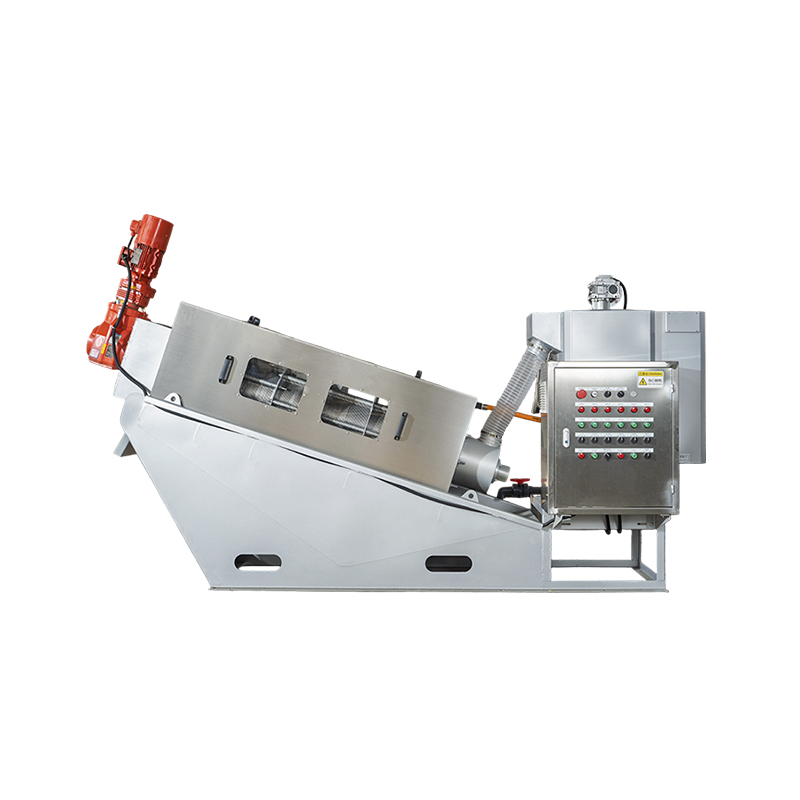
The screw press feeds sludge into a cylindrical screen basket through which a helical screw rotates slowly — typically at 2–5 RPM. As the sludge advances along the screw, the pitch decreases and the back pressure increases, compressing the sludge against a cone-shaped end resistance plate. Filtrate drains continuously through the screen. Screw presses operate at very low rotational speeds, which translates to low noise, low energy consumption, and minimal wear. They are increasingly favoured for small to medium-scale installations — particularly in food processing, paper mills, and package treatment plants — where simplicity and low operating cost outweigh the moderate cake dryness (typically 15–22% dry solids) relative to centrifuges.
Filter Press (Plate and Frame)
The filter press is a batch-operated machine consisting of a series of recessed polypropylene plates fitted with filter cloths. Sludge is pumped into the chambers between plates at progressively higher pressures — up to 15–16 bar in high-pressure membrane versions — forcing filtrate through the cloth while solids build up as a cake. When the chambers are full, the press opens automatically and cake falls from the plates. Filter presses achieve the highest cake dryness of any dewatering technology — 35–50% dry solids is achievable with membrane plate designs — making them the preferred choice where downstream thermal drying or incineration requires minimum moisture content. The batch cycle and the need for cloth washing and maintenance are the primary operational trade-offs.
| Machine Type | Operation Mode | Typical Cake Dryness | Energy Use |
|---|---|---|---|
| Belt Filter Press | Continuous | 18–25% DS | Low |
| Centrifuge Decanter | Continuous | 22–30% DS | High |
| Screw Press | Continuous | 15–22% DS | Very Low |
| Filter Press | Batch | 35–50% DS | Medium |
The Role of Chemical Conditioning in Dewatering Performance
Virtually all mechanical dewatering machines perform significantly better when the sludge has been chemically conditioned beforehand. Raw sludge — particularly activated sludge from biological treatment — consists of fine colloidal particles with strong negative surface charges that repel each other and trap water within a stable gel-like matrix. Without conditioning, the particles pass through filter media and the bound water cannot be mechanically removed.
Polymer flocculants — most commonly cationic polyacrylamides — are dosed into the sludge feed line upstream of the dewatering machine. The polymer neutralises the surface charge on sludge particles, allowing them to aggregate into larger flocs that release bound water and are retained by the filter medium. Polymer dose typically ranges from 4 to 12 kg of active polymer per tonne of dry solids, depending on sludge origin, volatile solids content, and the dewatering technology used.
Conditioning optimization is one of the most cost-effective levers available to plant operators. Underdosing leaves cake dryness below potential; overdosing wastes polymer and can create sticky cake that impairs belt or screw discharge. Jar testing and pilot dewatering trials with candidate polymers should precede any full-scale installation to establish the optimal dose-response curve for the specific sludge being processed.
Key Performance Parameters to Specify and Measure
Selecting and evaluating a sludge dewatering machine requires clarity on a core set of performance metrics. These parameters define whether a machine meets its process duty and should be contractually specified for any capital procurement.
- Cake dry solids content (%DS): The percentage of solids in the dewatered cake by mass. Higher %DS means lower cake weight and volume for disposal. Target values depend on the downstream process — landfill typically requires >20% DS, co-incineration often requires >25% DS, and some composting operations accept 18–22% DS.
- Solids capture rate (%): The percentage of incoming solids that end up in the cake rather than in the centrate or filtrate. Values below 90–95% indicate excessive solid loss to the return stream, which increases load on the upstream treatment process. Well-conditioned sludge on a properly operated centrifuge should achieve 95–98% capture.
- Throughput (kg DS/hr): The mass of dry solids processed per hour at the specified cake dryness and capture rate simultaneously. This is the design basis for equipment sizing and must reflect peak sludge production, not average loads.
- Polymer consumption (kg polymer/tonne DS): A direct operating cost driver. Should be measured under steady-state conditions at the rated throughput, not under favourable laboratory conditions.
- Energy consumption (kWh/tonne DS): Particularly important for centrifuges and high-pressure filter presses. Lifecycle energy cost can exceed capital cost over a 15–20 year machine life.
How to Select the Right Dewatering Machine for Your Application
No single dewatering technology is optimal across all sludge types and operational contexts. Selection should be driven by a structured evaluation of the following factors.
Sludge Characteristics
Sludge origin determines dewaterability. Primary sludge (settled raw solids) dewaters more easily than activated (biological) sludge, which in turn dewaters more easily than mixed digested sludge with high volatile solids. Industrial sludges vary enormously — oily sludge from petrochemical processes, fibrous sludge from paper mills, and inorganic sludge from mining tailings all behave differently under mechanical pressure and centrifugal force. Bench-scale dewatering tests on representative sludge samples are essential before finalising equipment selection.
Required Cake Dryness
If downstream thermal drying or co-incineration is planned, maximising cake dryness has a direct fuel cost benefit — every 1% increase in cake DS reduces drying energy by approximately 2–3%. In this scenario, the higher capital and operating cost of a membrane filter press may be fully justified. Where sludge goes to agricultural land spreading or composting at lower dryness targets, a screw press or belt press may deliver adequate performance at lower cost.
Available Footprint and Installation Constraints
Centrifuges and screw presses have compact footprints and are well-suited to containerised or modular installations. Belt filter presses require more floor area and overhead clearance for belt tracking and wash systems. Filter presses with large plate counts can be substantial in length — up to 15–20 metres for high-capacity units — and require significant structural loading capacity in the building floor.
Operator Skill and Maintenance Capacity
Centrifuges and filter presses have more complex maintenance requirements than screw presses or belt presses. Sites with limited maintenance staff or remote locations benefit from the simplicity and robustness of slow-speed screw press technology, which has fewer wear components and does not require precision balancing or high-speed bearing maintenance.
Let's Cooperate with Yixing Hengye Environmental Protection
Contact Us
- Product Categories
- Sludge Dewatering Machine
- Roller Filter
- Dissolved Air Flotation Machine(DAF)
- Rotary Mechanical Bar
- Dosing Device
- Aerator
- Biological Packing Material
- Other Wastewater Treatment Equipment
- Contact Us
-
-
[email protected]

[email protected] -
+86-13812201185

-
+86-13812201185

-
No. 20, Saite Road, Gaoyao Village, Gaocheng Town, Yixing City, Wuxi City, Jiangsu Province, China

-



