

 English
  русский
Sewage Treatment Solutions & Wastewater Treatment Equipment Guide
Effective sewage treatment solutions reduce a complex mixture of pathogens, suspended solids, dissolved organics, nutrients, and trace contaminants down to effluent quality that meets discharge or reuse standards. No single technology achieves this across the full range of wastewater characteristics and flow volumes—successful treatment depends on selecting and sequencing the right combination of physical, biological, and chemical processes, and equipping each stage with appropriately sized, durable wastewater treatment equipment.
The scale of the challenge is significant. The UN estimates that more than 80% of global wastewater is discharged untreated, contributing to waterborne disease, eutrophication, and freshwater scarcity. As regulatory frameworks tighten in developing economies and discharge limits become more stringent in developed ones, the demand for both municipal sewage infrastructure and industrial wastewater treatment systems continues to grow across all regions.
Content
- 1 The Treatment Process: Stages and What Each Removes
- 2 Core Wastewater Treatment Equipment Categories
- 3 Industrial vs. Municipal Sewage Treatment: Different Problems, Different Solutions
- 4 Decentralised and Package Sewage Treatment Solutions
- 5 Energy Efficiency and Resource Recovery in Modern Treatment Plants
- 6 Selecting Wastewater Treatment Equipment: Critical Specification Inputs
The Treatment Process: Stages and What Each Removes
Sewage treatment is structured around sequential stages, each targeting a specific category of pollutant. Understanding what each stage removes clarifies which equipment is essential versus optional for a given wastewater profile.
Preliminary and Primary Treatment
Incoming sewage first passes through screens and grit chambers that remove large solids, plastics, rags, and abrasive particles that would damage downstream equipment. Primary clarifiers then allow settleable suspended solids—typically 50–70% of total suspended solids—to settle out as primary sludge while floatable materials are skimmed. This stage requires no biological activity and produces an effluent with substantially reduced BOD load heading to secondary treatment.
Secondary (Biological) Treatment
Secondary treatment is where the majority of dissolved and colloidal organic matter—measured as BOD and COD—is degraded by microorganisms. The dominant technologies are:
- Activated sludge systems — suspended biomass is maintained in aeration tanks and recycled from secondary clarifiers. Conventional activated sludge (CAS) achieves BOD removal efficiencies above 95% and is the most widely deployed secondary treatment process globally.
- Sequencing batch reactors (SBR) — a single tank performs aeration, settling, and decanting in timed cycles, eliminating the need for separate clarifiers. SBR systems are particularly well-suited to variable flow conditions and compact site footprints.
- Moving bed biofilm reactors (MBBR) — plastic carrier media suspended in the aeration tank provide attachment surfaces for biofilm, increasing biomass concentration per unit volume and allowing retrofit of existing tanks to higher capacity.
- Membrane bioreactors (MBR) — ultrafiltration membranes replace secondary clarifiers, producing a clarified effluent of consistently high quality suitable for direct reuse applications. Capital cost is higher than conventional systems, but the smaller footprint and superior effluent quality are strong advantages in constrained sites or reuse projects.
Tertiary and Advanced Treatment
Where secondary effluent does not meet discharge or reuse standards, tertiary treatment removes residual suspended solids, nutrients (nitrogen and phosphorus), and pathogens. Processes include sand filtration, chemical phosphorus precipitation, biological nitrogen removal through nitrification/denitrification, UV disinfection, chlorination, and advanced oxidation for trace organic contaminants. Tertiary treatment is mandatory for effluent entering sensitive receiving waters or being recycled for irrigation and industrial reuse.
Core Wastewater Treatment Equipment Categories
Each treatment stage relies on specific equipment types. The following covers the primary equipment categories encountered across municipal and industrial wastewater treatment plants.
Screens and Grit Removal Equipment
Bar screens (coarse, fine, and micro) are the first line of defence, removing solids above a defined aperture size. Mechanically raked screens automate screenings removal to reduce operator intervention. Grit classifiers and vortex grit chambers remove sand, gravel, and inorganic particles that cause accelerated wear in pumps, impellers, and aeration equipment downstream.
Clarifiers and Sedimentation Tanks
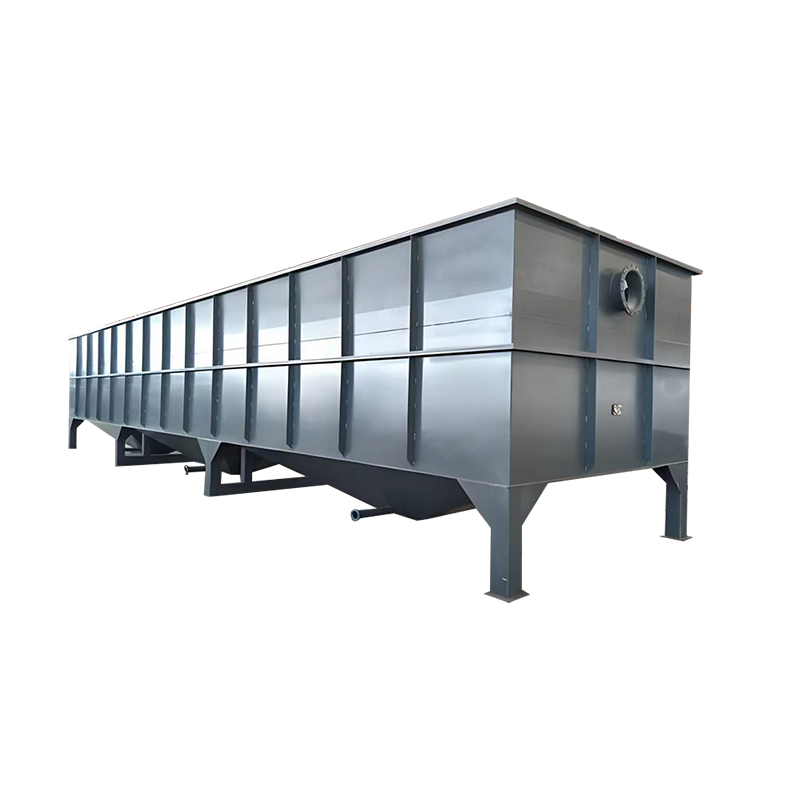
Circular and rectangular clarifiers with slow-moving scraper mechanisms collect settled sludge at the base and scum at the surface. Lamella (inclined plate) settlers dramatically reduce the footprint required for equivalent settling performance by using closely spaced inclined plates to shorten effective settling distance—a valuable option where land area is constrained.
Aeration Systems
Aeration accounts for 50–60% of energy consumption in a typical activated sludge plant, making equipment selection critical to operating cost. Fine bubble diffuser systems achieve oxygen transfer efficiencies (OTE) of 20–35% at standard conditions—significantly better than coarse bubble or surface aerators—and are the standard choice for new installations. Blower technology has shifted substantially toward high-efficiency turbo blowers and variable-speed drives that match air supply precisely to biological oxygen demand in real time.
Pumps and Mixers
Submersible and dry-well centrifugal pumps handle raw sewage, return activated sludge (RAS), and waste activated sludge (WAS) flows throughout the plant. Non-clog impeller designs prevent rag accumulation. Submersible mixers maintain solids in suspension in anoxic zones and equalisation basins without introducing oxygen, supporting biological nitrogen removal.
Sludge Treatment Equipment
Sludge management represents a significant cost centre in any treatment plant. Gravity thickeners and dissolved air flotation (DAF) thickeners increase sludge solids concentration before digestion or dewatering. Anaerobic digesters stabilise sludge and recover biogas—a facility treating 100,000 m³/day can generate sufficient biogas to cover 30–50% of its electricity demand. Dewatering equipment—belt filter presses, centrifuges, and screw presses—reduces sludge volume for disposal or beneficial land application.
| Equipment Type | Treatment Stage | Primary Function | Key Selection Criterion |
|---|---|---|---|
| Mechanical Bar Screen | Preliminary | Remove large solids | Bar spacing, channel width |
| Circular Clarifier | Primary / Secondary | Settle suspended solids | Surface overflow rate (m³/m²/h) |
| Fine Bubble Diffuser | Secondary (biological) | Oxygen transfer to biomass | SOTE (%), fouling resistance |
| MBR Membrane Module | Secondary / Tertiary | Solids separation + clarification | Flux rate, cleaning protocol |
| UV Disinfection Unit | Tertiary | Pathogen inactivation | UV dose (mJ/cm²), UVT of effluent |
| Centrifuge / Belt Press | Sludge treatment | Sludge dewatering | Cake dry solids %, polymer demand |
Industrial vs. Municipal Sewage Treatment: Different Problems, Different Solutions
Municipal sewage treatment plants handle domestic wastewater of relatively predictable composition—high BOD, suspended solids, pathogens, and nutrients—at flows that vary diurnally but follow predictable patterns. Industrial wastewater presents a fundamentally different challenge: composition varies by sector, flow can be highly intermittent, and the pollutant profile often includes substances that inhibit biological treatment or require specialised removal processes.
Food and Beverage Processing
High organic loading (BOD 1,000–5,000 mg/L is common), fats, oils, and greases (FOG), and fluctuating pH characterise food processing wastewater. DAF systems are essential for FOG removal ahead of biological treatment. Anaerobic pre-treatment using UASB (upflow anaerobic sludge blanket) reactors is economically attractive given the high organic load—a single UASB treating brewery effluent can produce enough biogas to offset a significant portion of site energy demand.
Textile and Dyeing Industries
Textile wastewater contains synthetic dyes, surfactants, and auxiliary chemicals that are resistant to conventional biological degradation. Advanced oxidation processes (AOPs)—ozonation, Fenton reaction, UV/H₂O₂—are required to break down chromophore structures before or after biological treatment. Color removal is often the binding constraint on discharge compliance, not BOD.
Pharmaceutical and Chemical Manufacturing
Trace active pharmaceutical ingredients (APIs), solvents, and complex organic compounds require activated carbon adsorption, membrane filtration, or incineration of concentrated streams. Biological treatment alone cannot achieve the required effluent quality for many pharmaceutical wastewater streams, and the risk of inhibiting biomass with toxic compounds requires careful equalisation and pre-treatment before any biological stage.
Decentralised and Package Sewage Treatment Solutions
Not all wastewater treatment challenges suit large centralised infrastructure. Remote communities, resorts, highway service areas, industrial sites, and housing developments in unsewered areas require compact, self-contained sewage treatment solutions that can be installed quickly, operated with minimal trained staff, and maintained without specialist workshop facilities on site.
Package treatment plants—factory-assembled units shipped in steel or GRP tanks—bring complete secondary treatment into a single footprint. Common configurations include:
- Integrated fixed-film activated sludge (IFAS) — combines biofilm media with suspended growth in a single reactor, reducing tank volume requirements by 30–40% compared with conventional activated sludge at equivalent BOD removal.
- Rotating biological contactors (RBC) — slowly rotating discs partially submerged in wastewater support attached biofilm that alternately contacts the wastewater and the air above it. RBCs have low energy consumption and operate reliably with minimal supervision, making them well-suited to unmanned or infrequently visited sites.
- Extended aeration systems — long hydraulic retention times and low organic loading rates produce a stable, well-nitrified effluent with low sludge yield, reducing the frequency of sludge removal—an important advantage where tanker access is limited.
Containerised treatment plants have become an increasingly popular format for rapid deployment in post-disaster reconstruction, military operations, and construction camp water management. A containerised MBR system can treat flows of 50–500 m³/day within a standard 20 ft container footprint and produce effluent meeting irrigation reuse standards.
Energy Efficiency and Resource Recovery in Modern Treatment Plants
The framing of wastewater treatment has shifted over the past decade from a waste disposal problem to a resource recovery opportunity. Energy-neutral and energy-positive treatment plants are now achievable at municipal scale through a combination of process optimisation and biogas utilisation.
Key strategies driving this shift include:
- Maximising primary sludge capture — diverting organic matter to anaerobic digestion rather than oxidising it in secondary aeration preserves its energy content. Enhanced primary treatment using chemically enhanced primary sedimentation (CEPS) increases primary sludge yield and reduces secondary aeration load simultaneously.
- Anaerobic co-digestion — supplementing sewage sludge with high-energy external substrates (food waste, fats from FOG traps, agricultural residues) can increase biogas production by 50–150% with minimal additional capital investment where digester capacity is underutilised.
- Nutrient recovery — struvite (magnesium ammonium phosphate) crystallisation systems recover phosphorus from sludge liquors as a slow-release fertiliser, simultaneously reducing the phosphorus recycle load that otherwise demands additional chemical dosing in the liquid treatment train.
- Advanced blower control — real-time ammonia and dissolved oxygen sensors coupled with variable-speed blower drives reduce aeration energy consumption by 20–35% compared with fixed-speed systems at constant air flow.
Selecting Wastewater Treatment Equipment: Critical Specification Inputs
Equipment procurement without adequate characterisation of the wastewater being treated is a primary cause of underperforming plants and costly retrofits. A reliable specification requires at minimum:
- Design flow rates — average daily flow, peak hourly flow, and minimum flow; the ratio between peak and average determines the sizing of screens, pumps, and clarifiers.
- Wastewater characterisation — BOD, COD, TSS, TN, TP, pH, temperature, and any industry-specific parameters (heavy metals, specific organics, TDS) that affect process selection or materials of construction.
- Effluent quality requirements — the discharge consent or reuse standard the treated effluent must meet, expressed as maximum concentration limits and any seasonal or receiving water-body-specific conditions.
- Site constraints — available footprint, headroom limitations, access restrictions for maintenance equipment, proximity to sensitive receptors (noise, odour), and ground conditions affecting civil foundations.
- Utility availability — electrical supply capacity, water availability for dilution or backwash, and the presence or absence of natural gas infrastructure affecting sludge management options.
- Operational model — continuous staffed operation, semi-automated with periodic attendance, or fully automated remote-monitored; this determines the acceptable complexity of control systems and the redundancy requirements for critical equipment.
Providing complete specification data enables equipment suppliers and process engineers to produce designs that are right-sized from the outset—avoiding both the capital waste of oversized equipment and the compliance risk of systems that cannot meet consent conditions at design flow.
Let's Cooperate with Yixing Hengye Environmental Protection
Contact UsRelated Products
- Product Categories
- Sludge Dewatering Machine
- Roller Filter
- Dissolved Air Flotation Machine(DAF)
- Rotary Mechanical Bar
- Dosing Device
- Aerator
- Biological Packing Material
- Other Wastewater Treatment Equipment
- Contact Us
-
-
[email protected]

[email protected] -
+86-13812201185

-
+86-13812201185

-
No. 20, Saite Road, Gaoyao Village, Gaocheng Town, Yixing City, Wuxi City, Jiangsu Province, China

-



