

 English
  русский
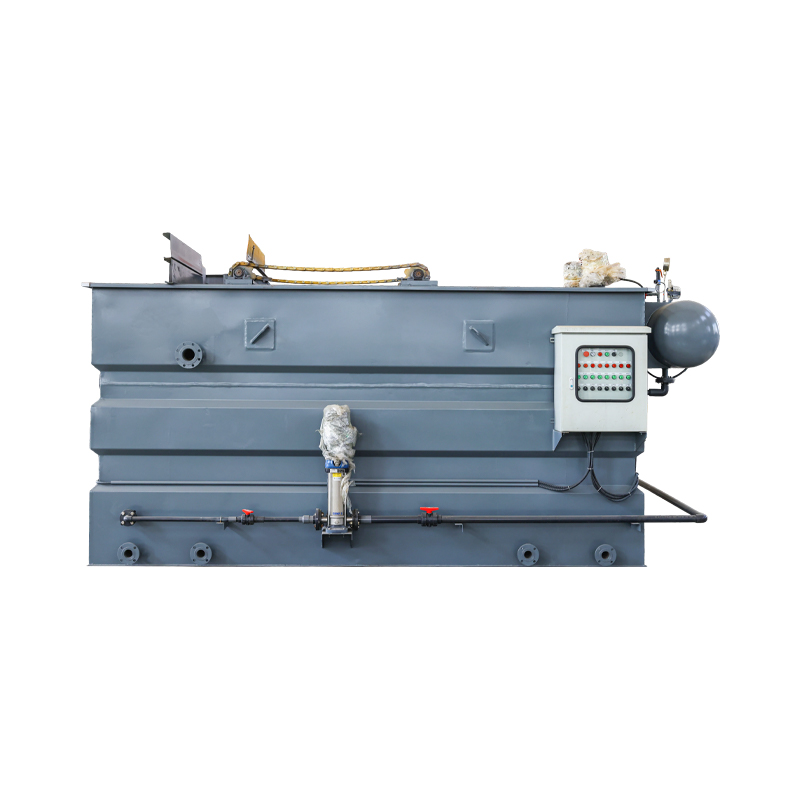
Dissolved air flotation (DAF) is a commonly used water treatment device for removing suspended solids and dissolved gases from water. It employs dissolved air flotation technology, which involves dissolving gases in water to form microbubbles, and then using these bubbles to contact suspended particles to achieve solid-liquid separation.
Working principle
The working principle of a dissolved air flotation (DAF) system is based on the adhesion of air bubbles to suspended particles and their faster rising speed than water, causing the particles to float and separate from the water. In the DAF system, gas is dissolved in water under pressure to form a saturated solution. Then, the dissolved gas is released by depressurization, causing the gas to rapidly transition from a saturated to a supersaturated state, forming microbubbles of 20-30 μm . These microbubbles combine with suspended solids in the wastewater, reducing their specific gravity until they float to the surface, forming a large amount of scum. This scum is then removed by a chain scraper installed on the flotation tank, achieving the desired treatment effect .
Features :
1. It occupies a small area, produces a high amount of water per unit area, and has a low moisture content in the slag.
2. It has a high surface area and adsorption capacity, and can effectively remove suspended solids from wastewater of different concentrations .
3. It has a wide range of applications in fields such as papermaking, printing and dyeing, leather making, electroplating, textiles, petroleum, chemicals, and food.
4. The process is simple, the equipment is available in a variety of materials (Q235, SS304, SS316, etc.) , and it is easy to manage and maintain .
5. It has a high degree of automation, enabling it to operate 24 hours a day without interruption, while its energy consumption is relatively low.
-
0+Over 10 Years of Wastewater Treatment Solutions
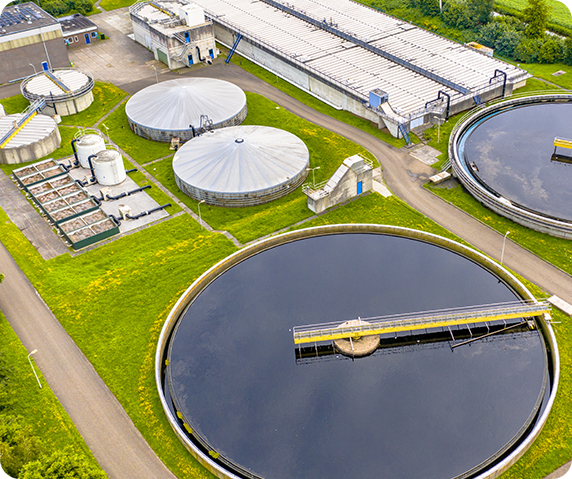


With a strong technical foundation and an ISO-certified quality system, Hengye helps clients across various industries enhance treatment efficiency, reduce operating costs, and meet global environmental standards.
-
Established in 2015

-
Certified Under ISO 9001 Quality Management System
-
Engaged in in-depth Collaborations with Multiple Academic Institutions
-
Professional Environmental Equipment Manufacturing Team
-
 2026-10-21
 -
2026-10-14
-
2026-10-07
-
2026-09-30
-
2026-09-23
Industry Knowledge
The Physics Behind Dissolved Air Flotation and Why It Outperforms Gravity Settling for Certain Waste Streams
Gravity sedimentation relies on the density differential between suspended solids and water to drive particle separation. For contaminants with densities close to water — emulsified oils, fine colloidal particles, algae, and biological floc — settling rates are extremely slow, often making clarifier footprints impractically large for the required hydraulic retention time. Dissolved air flotation machines solve this by reversing the separation vector: instead of waiting for particles to sink, micro-bubbles generated under pressure attach to contaminant particles and carry them upward to the surface as a floated sludge layer.
The process begins in a pressurization vessel where a recycle stream of clarified effluent is saturated with air at typically 3–6 bar. When this supersaturated stream is released through pressure reduction nozzles into the flotation tank, air comes out of solution as micro-bubbles with diameters in the range of 10–100 µm. Bubble size is critical: bubbles smaller than 40 µm rise slowly enough to maximize contact time with suspended particles, while bubbles larger than 150 µm rise too quickly and bypass much of the contaminant load.
The bubble-particle attachment mechanism is governed by surface chemistry. Hydrophobic particles — oils, waxes, and certain synthetic fibers — attach readily to air bubbles without chemical conditioning. Hydrophilic particles such as clay minerals and metal hydroxide floc require coagulant and flocculant addition to render their surfaces sufficiently hydrophobic for effective bubble attachment. This distinction has direct implications for chemical dosing system design and operating cost projections.
Industrial Applications Where DAF Delivers Measurable Treatment Advantages
DAF systems are not universally superior to other clarification technologies — their advantages are most pronounced in specific wastewater profiles. Understanding where DAF performs best prevents over-specification in applications where simpler technologies would suffice, and under-specification in applications where gravity clarifiers would fail to meet discharge limits.
Industries where DAF consistently delivers strong performance include:
- Food and beverage processing — high fat, oil, and grease (FOG) concentrations from meat slaughtering, dairy, and edible oil refining respond exceptionally well to DAF, achieving FOG removal efficiencies of 90–98% in a single pass with appropriate chemical conditioning
- Printing and dyeing wastewater — colloidal dye particles and surfactant-stabilized emulsions that resist gravity settling are effectively captured by DAF flotation, reducing color and COD loads on downstream biological treatment
- Paper and pulp mills — fiber fines and filler particles (kaolin, calcium carbonate) are readily floated, enabling fiber recovery and reducing suspended solids in mill effluent simultaneously
- Leather tanneries — chrome-containing sludge and protein compounds from soaking and liming operations are concentrated into a flotation sludge layer with significantly lower moisture content than gravity-settled equivalents, reducing downstream dewatering load
- Plastic processing and surface coating — emulsified cutting oils and paint solids require coagulation-assisted DAF to break emulsions before flotation; when correctly conditioned, removal efficiencies exceed 85% for total suspended solids
Hengye Technology's project experience across these sectors has demonstrated that DAF performance is highly sensitive to the coagulation and flocculation steps immediately upstream of the flotation tank. Investing in correct chemical conditioning system design consistently yields greater returns than over-sizing the DAF unit itself.
Key Design Parameters That Determine Long-Term DAF Reliability
DAF units that underperform in the field typically share a common set of design deficiencies traceable to the initial engineering stage. The most consequential parameters governing both separation efficiency and operational stability are hydraulic surface loading rate, recycle ratio, and inlet flow distribution geometry.
Hydraulic surface loading rate — expressed as cubic meters of influent per square meter of flotation tank surface area per hour — is the primary sizing variable. For most industrial applications, design values fall in the range of 3–8 m³/m²·h, with lower values applied to wastewater containing fine, slowly-rising floc and higher values permissible for coarser, rapidly-floating material. Exceeding the design loading rate during peak flow events causes hydraulic short-circuiting, where incoming flow disrupts the floated sludge blanket and carries unseparated solids into the clarified effluent outlet.
The recycle ratio — the fraction of clarified effluent pressurized and returned to generate micro-bubbles — typically ranges from 15–50% of the influent flow. Higher recycle ratios generate greater bubble volume and improve contact probability with suspended particles, but increase energy consumption from the recycle pump and pressurization system. Optimizing this parameter requires balancing treatment performance against operating cost over the full range of expected influent solids concentrations.
Inlet distribution is frequently under-engineered. Introducing pressurized recycle flow and conditioned influent in a turbulent, poorly distributed manner disrupts micro-bubble formation and causes uneven loading across the tank width — creating high-velocity channels where separation is ineffective while leaving other zones stagnant. Properly designed inlet baffles and diffuser arrangements are essential for achieving the plug-flow hydraulic conditions that maximize flotation efficiency.
Floated Sludge Characteristics and Downstream Management Considerations
The floated sludge layer produced by a DAF system differs substantially from gravity-settled sludge in both physical characteristics and downstream handling requirements. DAF float typically contains 2–6% dry solids by mass — significantly higher than the 0.5–1.5% solids concentration common in gravity clarifier underflow — which reduces the volumetric load on subsequent thickening and dewatering steps.
However, DAF sludge composition varies considerably with the upstream wastewater source. Float from food processing wastewater is predominantly organic, with high fat content that creates challenges for screw press dewatering — the compressible, greasy cake can reduce filter ring cleaning effectiveness and increase polymer demand. Float from chemical precipitation processes, by contrast, may contain metal hydroxide solids that are more amenable to mechanical compression but may require hazardous waste disposal pathways depending on heavy metal concentrations.
Sludge collector design — whether chain-driven scraper, rotating spiral collector, or hydraulic skimming — affects both the consistency of float removal and the degree of dilution water introduced into the sludge stream. Aggressive scraping at high speed can re-entrain floated solids back into the clarified zone; insufficiently frequent skimming allows the float layer to thicken excessively, increasing its specific gravity and causing portions to sink back into the tank. At Yixing Hengye Environmental Protection Technology Co., Ltd., DAF systems are designed with integrated sludge handling pathways — ensuring that collector type, skimming frequency, and downstream dewatering equipment capacity are specified as a coordinated system rather than selected independently, which is a common source of avoidable performance gaps in installations designed by equipment-only suppliers.
- Product Categories
- Sludge Dewatering Machine
- Roller Filter
- Dissolved Air Flotation Machine(DAF)
- Rotary Mechanical Bar
- Dosing Device
- Aerator
- Biological Packing Material
- Other Wastewater Treatment Equipment
- Contact Us
-
-
[email protected]

-
+86-13812201185

-
+86-13812201185

-
No. 20, Saite Road, Gaoyao Village, Gaocheng Town, Yixing City, Wuxi City, Jiangsu Province, China

-



